 简体中文

Glue Spraying vs. Roller Coating: Key Differences in Adhesive Application Solutions for Panel Lamination Production Lines
Glue Spraying vs. Roller Coating: A Detailed Analysis of the Key Differences in Adhesive Application Solutions for Panel Lamination Production Lines
The core competitiveness of a panel lamination production line often depends on one critical process: adhesive application. Even when laminating the same aluminum honeycomb panel or SIP panel, different adhesive application methods can lead to significant differences in peel strength, surface flatness, adhesive consumption, and machine downtime.
The real question is not simply whether adhesive can be applied to the panel. That is no longer a challenge. What really matters is whether the exact amount of adhesive required per square meter is consistently and accurately applied to the surface.
1. How the Glue Spraying Process Works
Glue spraying, also known as curtain coating or curtain glue application, works on a relatively straightforward principle.
The A and B components of two-component polyurethane adhesive are delivered separately by two metering pumps according to a preset mixing ratio. They are then mixed inside the mixing head. The mixed adhesive is subsequently fed into the glue applicator head, where it passes through a precisely adjustable, millimeter-level slit to form a continuous and uninterrupted adhesive curtain.
As the panel moves underneath at a constant production speed, the adhesive curtain falls vertically onto its surface, forming a uniform adhesive film. The panel then moves on to the core material positioning, facing sheet application, and pressing stations.
Throughout this process, the panel surface does not come into contact with any rollers, doctor blades, or scrapers.
This is the fundamental difference between glue spraying and roller coating: Glue spraying delivers a precisely metered amount of adhesive onto the panel through the metering pumps, rather than transferring adhesive through physical contact with rotating rollers.
Therefore, the applied adhesive quantity is primarily determined by three factors: pump output, conveyor speed, and applicator slit opening. It is largely independent of the panel's thickness, warping, or surface flatness.
A well-designed automatic glue spraying machine allows operators to set adhesive application parameters directly through the touchscreen, including adhesive consumption in g/m², A/B mixing ratio, conveyor speed, and applicator slit opening.
For example, when switching from aluminum honeycomb panels to SIP panels, operators can simply select the corresponding production recipe and apply the preset parameters. There is no need to repeatedly adjust roller gaps, measure coating thickness, or conduct trial runs.
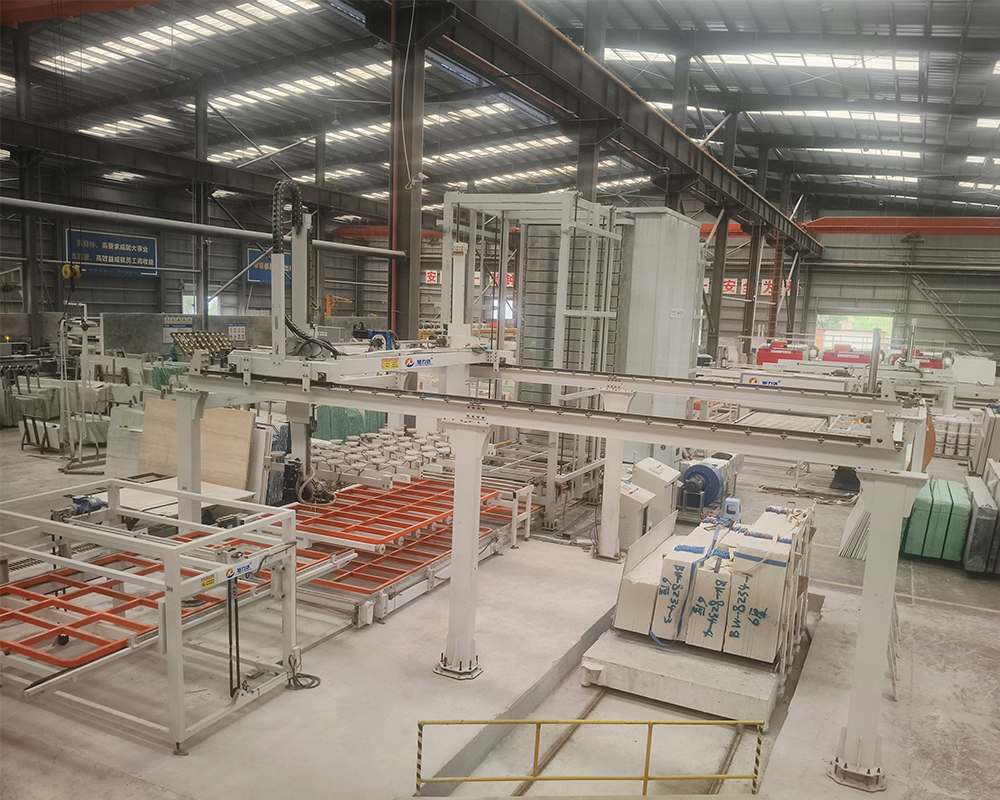
2. Why Roller Coating Struggles with Consistent Adhesive Application
Roller coating is a contact-based adhesive transfer process. Adhesive is transferred through multiple stages involving the glue tank, pickup roller, metering roller, transfer roller, and pressure roller.
The final adhesive film thickness depends on six main variables:
Roller gap settings
Speed ratios between different rollers
Adhesive viscosity
Adhesive temperature
Linear pressure of the pressure roller
Aging and wear of the rubber roller surfaces
These variables are interconnected and influence one another. Operators often have to rely on visual inspection, manual adjustments, and trial applications to achieve the desired coating thickness.
Even if the settings are correct today, a slight increase in workshop temperature tomorrow may change the adhesive viscosity and coating performance. When a new batch of adhesive arrives with different viscosity characteristics, the machine may need to be adjusted again.
Accurate two-component adhesive mixing ratios can also be more difficult to maintain in conventional roller coating systems.
The mixed adhesive is exposed over a relatively large area inside the glue tank and may circulate through the return system. Residual adhesive gradually accumulates on roller surfaces, tank walls, and scraper edges, where it continues to react and cure.
Over time, partially cured adhesive builds up on the rollers. This can cause uneven adhesive transfer, with excessive accumulation near the edges and insufficient application in the middle.
As a result, coating thickness can gradually drift during continuous production. Instead of being a precisely controlled numerical parameter, adhesive application becomes a condition that operators must constantly monitor and correct through experience.
3. Cleaning: A Greater Operational Burden for Roller Coating
Cleaning is another major challenge associated with roller coating systems.
If a conventional roller coating machine remains idle for more than 30 minutes, the adhesive may begin to cure. Once cured, adhesive can firmly bond to the roller surfaces.
Before production can resume, operators may need to disassemble the rollers, scrape off residual adhesive, and soak the components in solvent. This process can easily take one to two hours or even longer.
Solvent consumption is also considerable. Long-term exposure to cleaning solvents can accelerate the aging of rubber roller surfaces. As the rubber deteriorates, adhesive transfer becomes less uniform, making the coating process increasingly difficult to control.
This creates a vicious cycle: more cleaning, faster roller deterioration, and increasingly unstable coating performance.
By comparison, a glue spraying system has a much shorter adhesive delivery path, consisting mainly of the metering pumps, mixing head, connecting pipeline, and glue applicator head.
During shutdown, operators can remove and clean the applicator head, followed by a short cleaning-fluid circulation process through the adhesive delivery system.
The entire cleaning process can typically be completed in around 10–20 minutes, depending on the adhesive and machine configuration.
The applicator slit is a relatively simple flat opening without complicated internal corners or hidden areas where adhesive can easily accumulate.
This makes adhesive changes, color changes, and short production interruptions much easier to manage, significantly reducing unnecessary downtime.
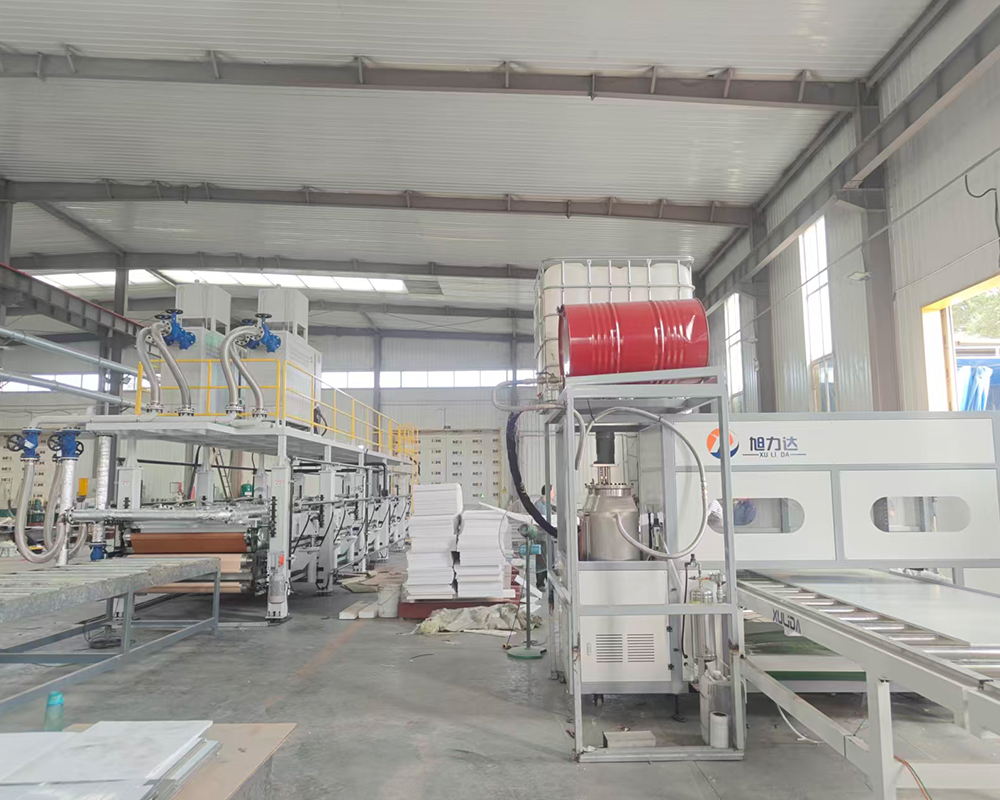
4. The Often-Overlooked Differences: Adhesive Consumption, Scrap Rate, and Labor Costs
The real difference between glue spraying and roller coating becomes even more apparent when total production costs are considered.
1) Adhesive consumption
With roller coating, adhesive losses can come from glue tank residues, adhesive returning through the circulation system, roller surface residues, and edge trimming.
These losses reduce the actual utilization of purchased adhesive.
Glue spraying eliminates the conventional open glue tank and roller transfer process. With a properly designed metering and cleaning system, adhesive utilization can be significantly improved.
For a production line operating continuously throughout the year, even a small reduction in adhesive waste can translate into substantial cost savings.
2) Product quality and scrap rate
Roller coating relies on physical contact and pressure during adhesive transfer. Variations in panel thickness, local warping, or surface depressions can affect the contact conditions, resulting in inconsistent adhesive application.
This may lead to air bubbles, insufficient bonding, and uneven adhesive distribution.
Glue spraying does not require the panel surface to contact coating rollers. Therefore, variations in panel thickness and surface flatness have much less influence on the metered adhesive quantity.
This helps maintain a more consistent adhesive layer and improves bonding stability, provided the substrate surface and subsequent pressing conditions meet the process requirements.
3) Labor and production efficiency
Roller coating lines generally require operators to monitor adhesive distribution, adjust roller gaps, and regularly disassemble and clean the rollers.
Automatic glue spraying systems significantly reduce these repetitive manual operations.
With preset production recipes and automated adhesive metering, operators can spend more time managing overall production rather than constantly correcting the coating process.
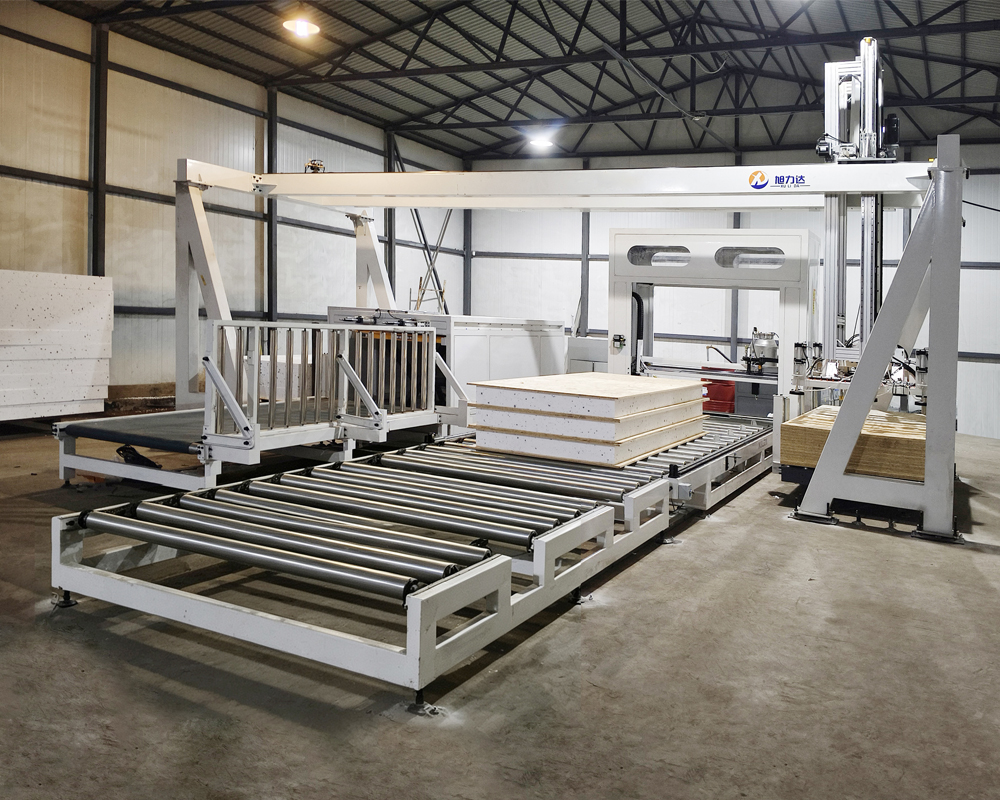
5. Key Factors to Consider When Selecting a Glue Spraying Machine
When evaluating an automatic glue spraying machine, three critical factors deserve particular attention.
1) Accurate metering and proportion control
Does the machine use reliable metering pumps with stable output? Can operators set the A/B mixing ratio directly through the touchscreen? Can the system maintain consistent adhesive delivery during continuous production?
2) Easy-to-clean applicator head
Can the applicator head be quickly disassembled and cleaned? Is the slit opening precisely adjustable? Is the structure designed to minimize adhesive residue and simplify maintenance?
3) A simplified adhesive delivery system
Are there unnecessary circulation loops or adhesive accumulation points? Can residual adhesive be effectively removed through a short and efficient cleaning process after production stops?
These three factors determine whether adhesive application can truly become a controllable and repeatable process rather than a manual operation that depends heavily on operator experience.
Conclusion: Precise Adhesive Application Creates a Competitive Advantage
The competitiveness of a panel lamination production line ultimately comes down to that thin layer of adhesive between the materials.
Whoever controls every gram of adhesive more accurately has a better opportunity to achieve consistent surface flatness, reliable peel strength, and lower production costs.
This is where glue spraying demonstrates its value.
It transforms adhesive application from an experience-dependent process requiring constant manual adjustment into a parameter-controlled operation that can be programmed, repeated, and consistently delivered.
For manufacturers of aluminum honeycomb panels, SIP panels, refrigerated truck body panels, cleanroom panels, insulation boards, and other composite materials, choosing the right adhesive application technology is an important step toward improving production efficiency and product quality.
 How Is the After-Sales Service of a Direct Manufacturer of C
 Glue Spraying vs. Roller Coating: Key Differences in Adhesiv
 What is the difference between a standalone fully automatic
 Panel Laminating Equipment Accelerates Its Transition Toward