 简体中文
Key Differences Between Glue Spraying Production Lines and Roller Glue Application Production Lines
In the panel coating and composite bonding industry, glue spraying production lines and roller glue application production lines are two mainstream types of adhesive application equipment. Although both are designed for the same basic purpose, they differ significantly in their working principles, application accuracy, adhesive consumption, production efficiency, and finished-product quality.
These differences are also among the key reasons why an increasing number of mid-to-high-end panel manufacturers are replacing traditional roller glue machines with precision glue spraying systems.
The most fundamental difference between the two lies in their adhesive application methods. A roller glue machine uses a contact-type roller coating process, while a glue spraying machine uses a non-contact precision curtain-coating process. This fundamental difference leads to significant differences in adhesive mixing, consumption, application quality, production processes, and operation.
1. Different Working Principles
A roller glue machine is a traditional adhesive application system with a relatively simple working principle. The rollers rotate and pick up adhesive from a glue tank, and the adhesive is then transferred onto the panel surface by adjusting the gap between the upper and lower rollers.
This process relies heavily on manual roller-gap adjustment and an open adhesive tank. As a result, the overall process is relatively less precise and has obvious limitations.
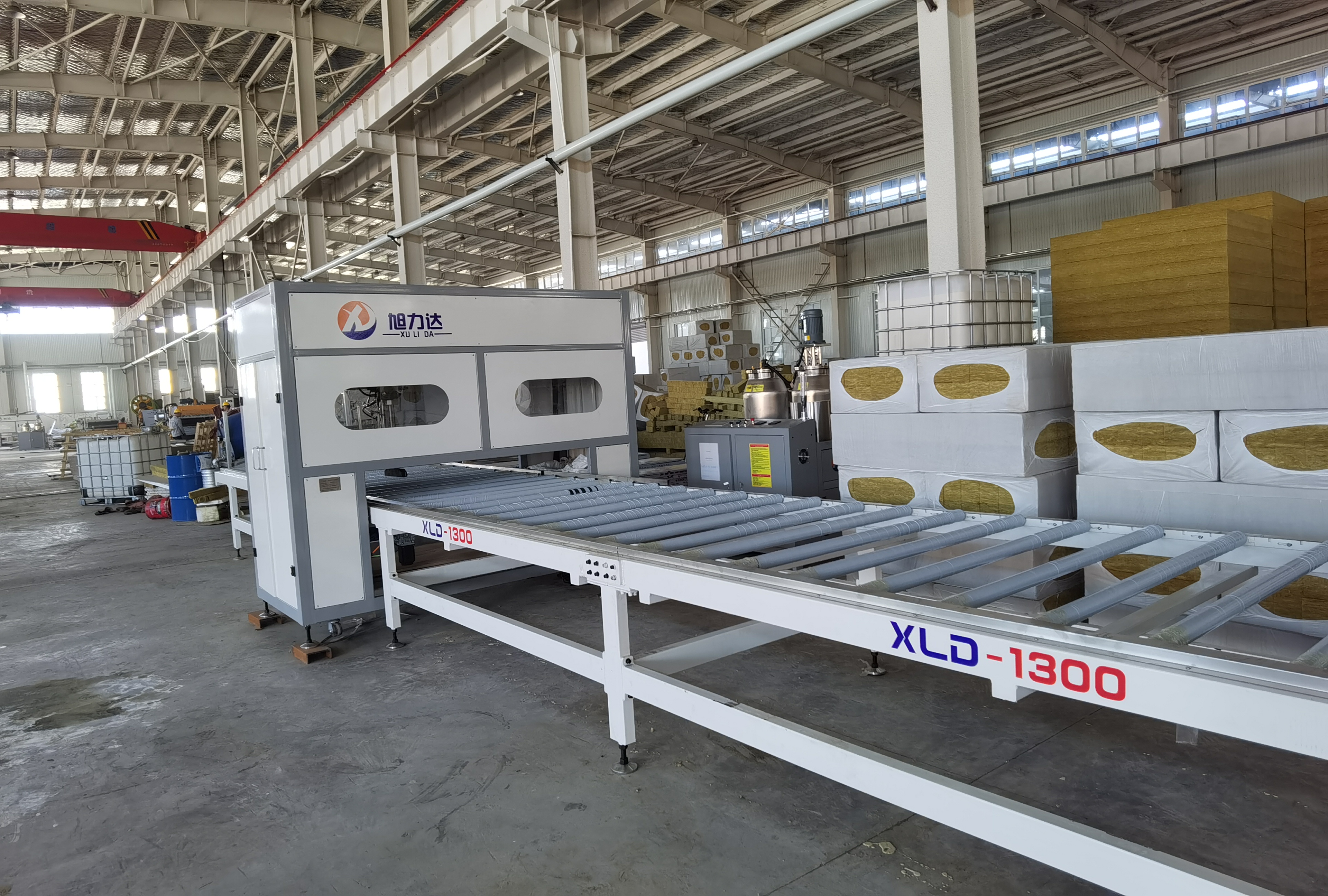
In contrast, a glue spraying machine uses a fully automatic metering and curtain-coating process. High-precision independent metering pumps accurately control the adhesive output, creating a uniform and stable adhesive curtain. The panel passes through the adhesive curtain at a constant speed, completing the coating process automatically.
This provides a higher level of automation and ensures consistent and standardized production results.
2. More Precise Adhesive Mixing Ratio
One of the most important advantages of a glue spraying machine is its high-precision adhesive mixing ratio.
Two-component AB adhesives are widely used in panel composite production, and the accuracy of the mixing ratio directly affects the bonding strength and service life of the finished panel.
A glue spraying machine is equipped with an independent dual-channel metering system. Components A and B are controlled separately by dedicated metering pumps. The required mixing ratio can be preset according to production requirements, and the machine automatically delivers the two components with high precision.
The mixing ratio remains stable throughout the production process, helping prevent quality problems caused by an incorrect ratio, such as incomplete curing, bonding failure, cracking, or brittle adhesive layers.
By comparison, traditional roller glue machines generally do not have a precision metering system. The two components often need to be mixed manually in advance. This can result in greater mixing-ratio errors, and once mixed, the adhesive has a limited working time. If it remains unused for too long, it may begin to cure, form lumps, and become unusable, negatively affecting production consistency and finished-product quality.
3. Lower Adhesive Consumption and Production Costs
A major advantage of glue spraying technology is its efficient use of adhesive, which can significantly reduce production costs.
The glue spraying machine adopts an on-demand metering and dispensing system. Adhesive is sprayed only when a panel passes through the application area, and the adhesive supply automatically stops when there is no panel.
This eliminates unnecessary adhesive output and greatly reduces waste.
Furthermore, the system does not require a large open adhesive tank, reducing adhesive loss caused by prolonged exposure to air, curing, deterioration, and residual adhesive accumulation.
A roller glue machine, on the other hand, requires adhesive to remain in the glue tank during operation. The high-speed rotation of the rollers can cause adhesive to splash, drip, and accumulate. Residual adhesive in the tank may also be difficult to reuse.
Over long-term production, these losses can result in significantly higher adhesive consumption and consumable costs.
4. More Uniform Coating and Wider Production Compatibility
In terms of coating quality and production adaptability, glue spraying machines also offer significant advantages.
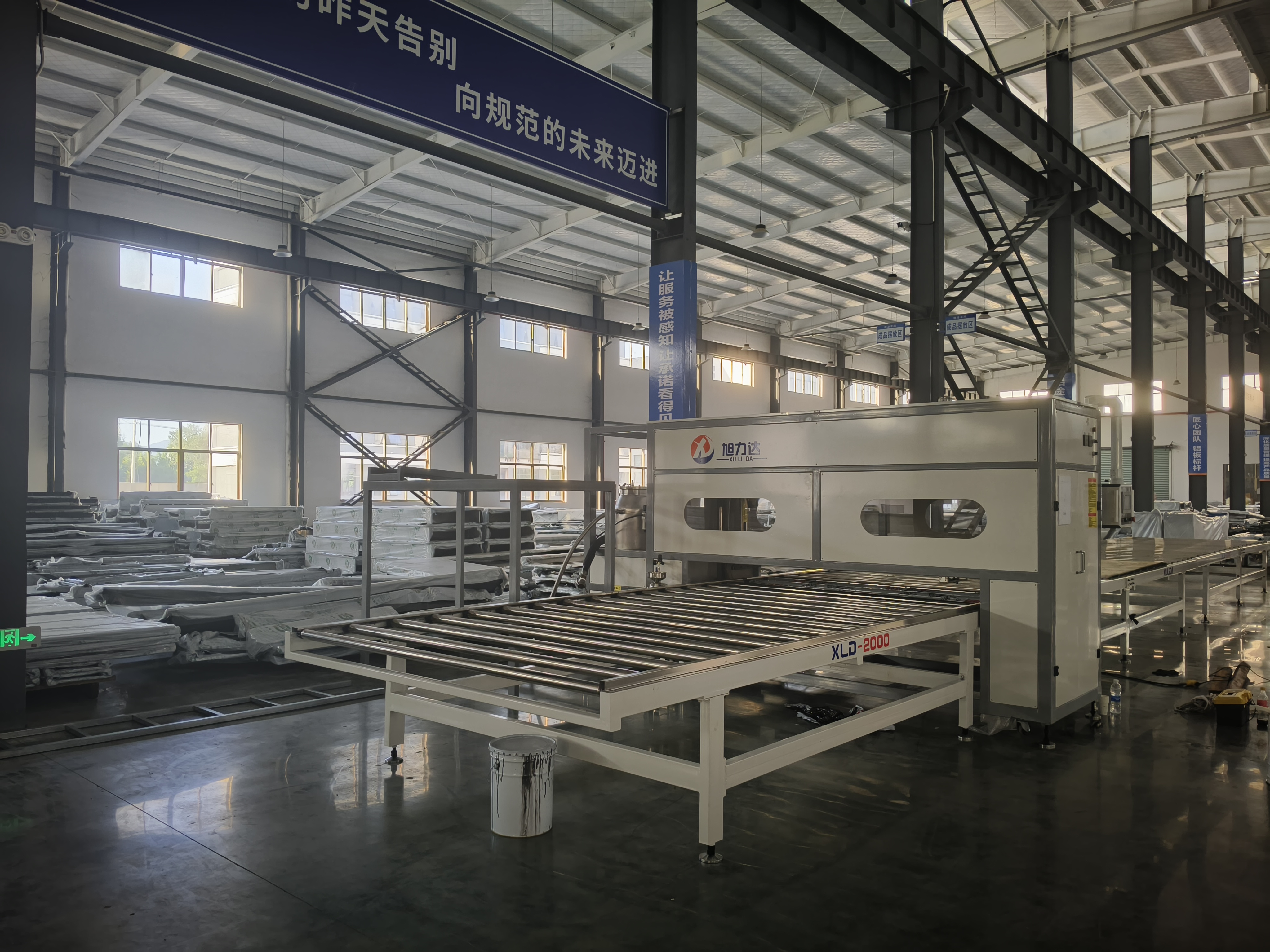
The adhesive curtain generated by a glue spraying machine is uniform and stable, with a controllable and consistent adhesive layer thickness. Even when the flatness of the panel is not perfect, the system can help reduce problems such as localized adhesive shortage, excessive adhesive accumulation, and uneven coating thickness.
This results in stronger and more consistent bonding and can improve the overall finished-product yield.
Roller glue machines rely on roller-gap adjustment to control adhesive application. The coating result can be affected by panel flatness, roller wear, and manual adjustment accuracy. The edges, corners, and ends of panels may therefore experience uneven adhesive application, potentially resulting in weak bonding or delamination.
In addition, glue spraying machines offer much wider production adaptability. They can be used for various large-format panels, including:
- Aluminum honeycomb panels
- Cleanroom panels
- SIP insulated panels
- Large-format air-duct panels
- Other composite sandwich panels
They can also support single-sided or double-sided adhesive application according to different production requirements.
Traditional roller glue machines are generally more suitable for smaller-format and relatively thin panels, which limits their application range in large-format panel production.
5. Easier Operation and Maintenance
Glue spraying machines are designed for simple, efficient, and user-friendly operation.
Key production parameters, including adhesive output, mixing ratio, and application speed, can be digitally controlled through the control system. Operators can set the required parameters quickly and accurately, allowing new operators to learn the machine in a short time.
The system also leaves relatively little residual adhesive, making shutdown cleaning and routine maintenance easier.
By comparison, roller glue machines require operators to repeatedly adjust the roller gap manually. This adjustment process can be time-consuming and requires considerable experience.
Adhesive can also easily accumulate and cure on the glue tank and rollers, increasing the workload for daily cleaning and maintenance and potentially reducing overall production efficiency.
Conclusion
Overall, traditional roller glue machines are mainly suitable for simple, cost-sensitive panel production where the process requirements are relatively basic. Their limitations include less precise adhesive mixing, higher adhesive consumption, less consistent coating quality, and more complicated manual adjustment and cleaning.
Glue spraying machines, by contrast, provide key advantages including:
Precise Mixing Ratio · Lower Adhesive Consumption · Uniform Coating · Easy Operation · Wide Production Compatibility
With these advantages, glue spraying technology is well suited to the standardized and large-scale production of mid-to-high-end composite panels, making it an important equipment solution for manufacturers looking to upgrade their adhesive application processes.
 How Is the After-Sales Service of a Direct Manufacturer of C
 Glue Spraying vs. Roller Coating: Key Differences in Adhesiv
 What is the difference between a standalone fully automatic
 Panel Laminating Equipment Accelerates Its Transition Toward