 简体中文

Technological Development Trends of SIP Panel Composite Production Lines (Adhesive Application, Cold/Hot Pressing, Automation)
I. Overview of General Trends
SIP (Structural Insulated Panel) composite production lines are evolving from traditional setups—characterized by standalone segmented machines, manual loading/unloading, and single-point adhesive application—toward integrated lines featuring continuous adhesive application, intelligent roller pressing, constant-temperature curing, and in-line inspection. Previously, factories relied on separate adhesive applicators and independent cold/hot presses; these fragmented, labor-intensive processes resulted in inconsistent bonding and high scrap rates. Modern production lines center on the adhesive application system, linking cold/hot press forming, CNC cutting, and in-line quality inspection to automate the entire SIP panel workflow—from facing sheet loading and gluing to assembly, pressure curing, and edge trimming/grooving. Competition now focuses not merely on basic bonding capabilities, but on adhesive uniformity, pressure stability, precise temperature control, and the implementation of a digital closed-loop system.
II. Technological Evolution of Adhesive Application Systems (Core Unit)
1. Equipment Configuration: Cantilever Applicator → Gantry Applicator → Continuous In-line Applicator
- Cantilever Applicator: The early mainstream choice; a moving arm applies adhesive at a single point. Suitable for small-batch, multi-size orders. Drawbacks include uneven adhesive thickness across large surfaces, potential gaps at edges/corners, and low efficiency; ideal for prototyping and sporadic orders at small-to-medium SIP processing plants.
- Gantry Applicator: Currently the market mainstay; features a gantry-style frame where the glue gun traverses the panel surface at a constant speed. Offers controllable adhesive thickness and supports the lamination of large-format OSB, magnesium oxide boards, and fiber cement boards. Supports switchable modes (full-surface coating, strip coating, intermittent application) and various core materials (EPS, PIR, rock wool), balancing mass production with flexibility for product changeovers.
- Continuous In-line Adhesive System: The industry's new direction; panels move at a constant speed along a conveyor while multiple fixed adhesive heads apply glue simultaneously. Eliminates the need for reciprocating gun movement, making it ideal for high-volume, standardized SIP panel production with significantly increased capacity. Places higher demands on adhesive viscosity and the stability of adhesive supply pressure. 2. Upgrades in Adhesive Supply and Coating Technology
1. Automatic Two-Component Adhesive Proportioning: A PLC automatically meters components A and B, replacing manual weighing and mixing; this eliminates bonding failures caused by mixing ratio errors and enables real-time monitoring of adhesive flow and temperature, with automatic alarms for anomalies.
2. Digital Control of Adhesive Layers: Parameters such as adhesive thickness, coating paths, and application zones can be preset. The system supports full-surface coating, frame coating, and dot-matrix coating to meet the bonding requirements of various fire-resistant core materials, while reducing adhesive waste and VOC emissions.
3. Anti-Curing Cleaning System: Automatic in-line cleaning of the adhesive gun reduces downtime caused by nozzle clogging and improves production line utilization rates.
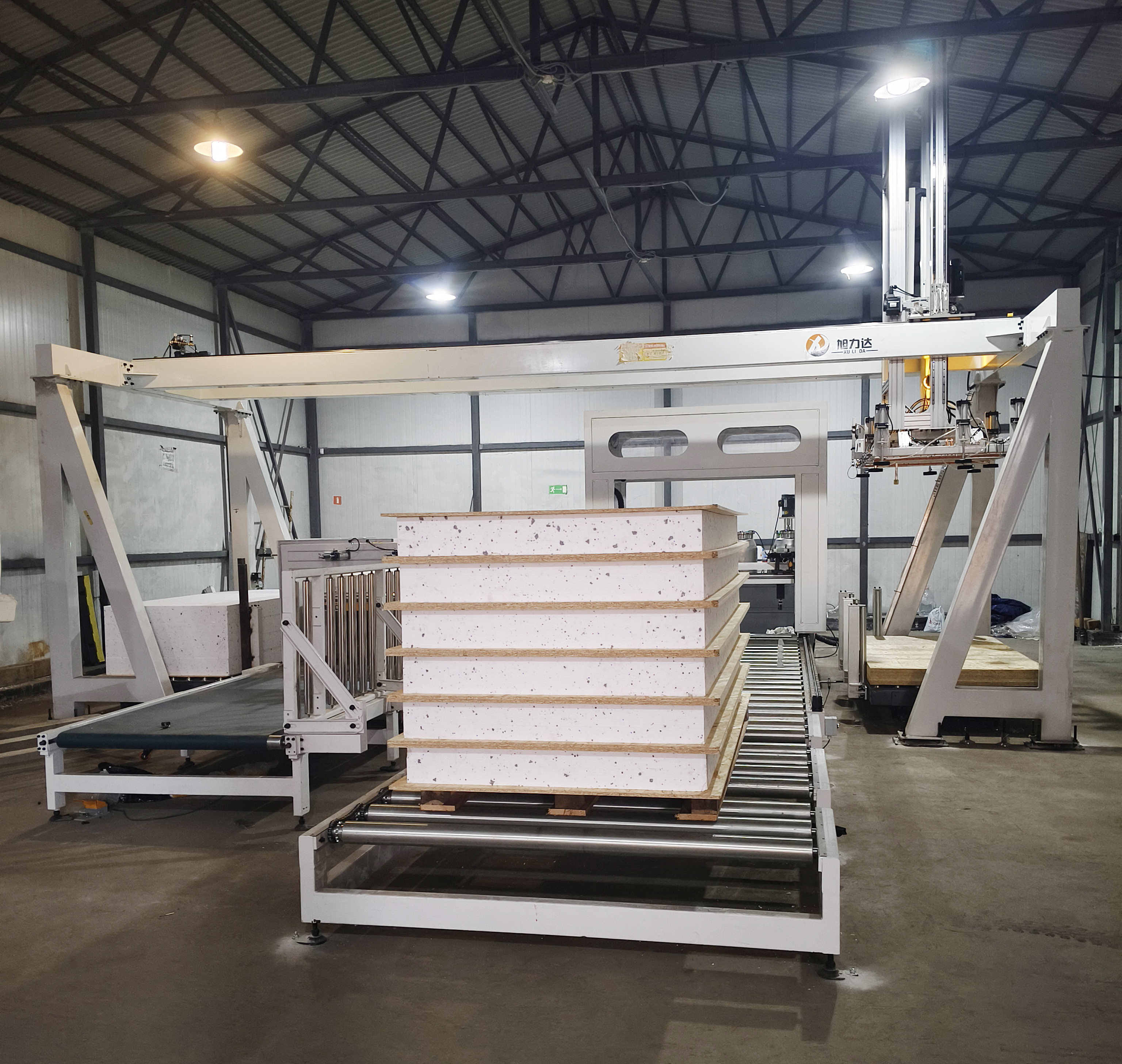
III. Technology Trends in Cold and Hot Press Lamination Units
Cold and hot pressing are critical for the forming and setting of SIP panels. After adhesive application and panel assembly, the boards enter the pressing stage. Industry trends favor **segmented temperature control, flexible pressure application, and integrated cold-hot pressing** over simple cold pressing or high-temperature hot pressing alone.
1. Cold Pressing Process: Curing occurs under pressure at ambient temperature. The advantage is that it prevents heat-induced shrinkage or deformation of EPS foam cores; the disadvantage is a long curing cycle that occupies many workstations. It is suitable for EPS-core SIPs. Traditional cold presses often apply fixed pressure, resulting in uneven pressure distribution across the panel surface. New-generation cold presses utilize multi-point pressure sensing to ensure balanced pressure across the panel.
2. Hot Pressing Process: Elevated temperatures accelerate adhesive curing, shorten holding times, and boost production capacity; this method is commonly used for PIR, phenolic, and rock wool core panels. The challenge lies in temperature control, as high temperatures can easily cause foam cores to melt or deform and panel facings to warp.
3. Integrated Cold-Hot Press: A key focus of industry upgrades. It features segmented temperature control: low-temperature pre-pressing for initial shaping, followed by gradient heating for curing, and finally cooling and pressure release. This balances production efficiency with core material protection (preventing deformation) and allows for flexible switching between EPS, PIR, and rock wool panel production, enabling a single line to handle multiple SIP product types.
4. Large-Surface Flexible Pressing: Uses zoned hydraulic cylinders to fine-tune pressure across different areas of the panel, solving issues such as center bulging or loose edges on large panels. Pressure data is stored in real-time, facilitating product quality traceability. IV. Directions for Full-Line Automation and Digital Upgrading
1. Automated Loading/Unloading & Panel Positioning
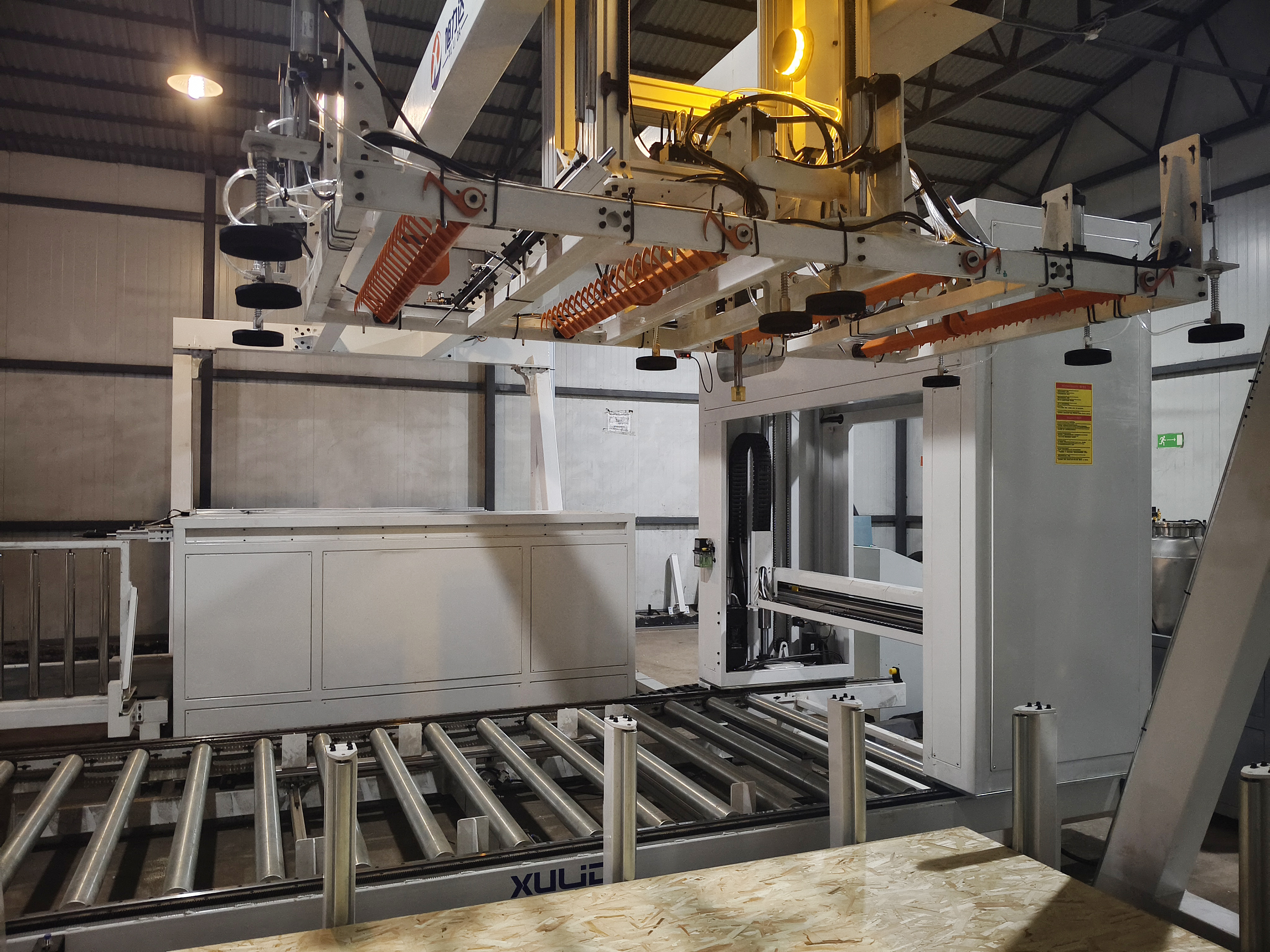
Vacuum suction cups handle loading, with automatic alignment and positioning to minimize handling damage and ensure precise alignment between face sheets and the core; eliminates the need for manual lifting of large panels, thereby reducing labor intensity and safety risks.
2. Continuous In-Line Panel Assembly
Automatic conveyance and alignment of face sheets and cores; the assembly mechanism ensures smooth bonding and prevents core shifting or misalignment, making it ideal for continuous production lines.
3. Integrated Downstream CNC Processing
Following composite curing, in-line CNC systems perform edge milling, grooving, and conduit cutout operations based on BIM drawings; finished panels are transported directly to the construction site for assembly, minimizing on-site cutting work.
4. In-Line Vision & Pressure Monitoring Systems (Emerging Configuration)
Vision cameras detect adhesive coating defects and surface scratches; pressure and temperature sensors capture real-time data linked to individual panel IDs for quality traceability; non-conforming panels are automatically rejected, reducing the defect rate of finished products.
5. Production Line MES Data Integration
Integration of all production line data into the MES system for unified management of output, adhesive consumption, pressing parameters (temperature/pressure), equipment faults, and work order information; supports flexible order scheduling and rapid changeovers between panel specifications, facilitating the transition from standalone equipment to a digital factory.
V. Customized Production Line Development for New Materials
As SIP core materials and face sheets diversify, production lines are shifting away from "one-size-fits-all" equipment toward customized upgrades:
1. Class A Fire-Resistant Cores (Rock Wool, Phenolic Foam): These cores are relatively rigid and porous, requiring precise adhesive application rates and superior wetting capabilities; upgrades include enhanced adhesive application systems and negative-pressure-assisted wetting to ensure strong bonding between the core and face sheets.
2. Magnesium-based & Fiber-Cement Face Sheets: These differ significantly from OSB in terms of surface porosity and water absorption; adhesive application methods and pressing pressures must be adjusted to prevent bond failure caused by excessive adhesive absorption.
3. Metal-Faced SIPs: Characterized by smooth surfaces requiring high adhesive bond strength; systems feature integrated surface pre-treatment mechanisms and specialized adhesive application routines. VI. Competitive Landscape of the Equipment Industry
1. Low-to-mid-end equipment: Sold as standalone units (e.g., individual adhesive applicators or cold presses); characterized by low automation and simple assembly; targeted at small processing plants with a focus on low prices; suffers from poor stability, making it unsuitable for large-scale projects or export orders (such as CE-certified projects).
2. Mid-to-high-end integrated production lines: Delivered as complete systems integrating adhesive application, cold/hot pressing, conveying, and CNC post-processing; supports CE and ISO standards; targets clients in domestic prefabricated construction, passive housing, and overseas modular building sectors; offers process commissioning and adhesive formulation support—moving beyond mere equipment sales to provide comprehensive SIP composite manufacturing solutions.
3. Future competition: Equipment manufacturers will shift from "machinery manufacturing" to **process service providers**, offering clients solutions that cover adhesive selection, parameter optimization (pressure and temperature), and complete panel production workflows.
VII. Existing Technical Bottlenecks
1. Fully continuous high-speed production lines: Continuous production of extra-large panels still faces issues such as panel misalignment and core material deformation; the high investment cost of high-speed lines makes them difficult for small and medium-sized factories to afford.
2. Rapid switching between core materials: Transitioning production between EPS, PIR, and rock wool involves complex adjustments to adhesive application parameters, pressing temperatures, and pressures; capabilities for rapid product changeovers require further optimization.
3. Online non-destructive testing: The cost of online detection for internal bonding defects (such as weak adhesion or interlaminar voids) remains high, preventing widespread adoption.
Core evolution trajectory for SIP panel composite production lines: Upgrading from single-point cantilever adhesive application to gantry or continuous application systems; evolving from standalone cold or hot presses to integrated cold/hot pressing units with zoned temperature control; shifting from independent standalone machines to fully automated integrated lines with digital online monitoring; and transitioning from simple machinery sales to providing comprehensive composite process solutions capable of meeting flexible production needs for diverse core materials and facing panels.
 How Is the After-Sales Service of a Direct Manufacturer of C
 Glue Spraying vs. Roller Coating: Key Differences in Adhesiv
 What is the difference between a standalone fully automatic
 Panel Laminating Equipment Accelerates Its Transition Toward